
- Home
- Other eye conditions
- Macular degeneration
Macular Degeneration
Age-related macular degeneration (AMD) damages the macula, the center of the retina that provides sharp reading and driving vision. The dry form progresses slowly; the wet form can take central vision in weeks but responds to injections when caught early. Dr. Michael E. Rom diagnoses and monitors AMD at Insight Eye Center in Mentor and coordinates treatment before vision is lost.
What is macular degeneration?
Age-related macular degeneration (AMD) is a disease of the macula, the small central area of the retina responsible for sharp, detailed vision — reading, faces, driving. As the macula deteriorates, central vision blurs or develops a blank or distorted spot, while side vision is spared. AMD is the leading cause of vision loss in Americans over 60.
There are two forms. Dry AMD, by far the more common, is a slow thinning of the macula with deposits called drusen; it progresses gradually over years. Wet AMD is less common but more serious: abnormal blood vessels grow beneath the retina and leak fluid or blood, and vision can worsen within days or weeks. Dry AMD can turn into wet AMD at any time.
AMD does not cause total blindness, because peripheral vision remains, but advanced disease can make reading and recognizing faces very difficult.
What are the symptoms of macular degeneration?
Early dry AMD often has no symptoms and is found at a dilated exam. As it advances, central vision blurs, print becomes hard to read without brighter light, colors look duller, and a blurred or blank spot appears in the middle of vision. Straight lines that suddenly look wavy or bent are a warning sign of wet AMD and need same-week attention.
- blurred central vision; difficulty reading fine print
- needing brighter light to read
- a dark, blank or blurry spot in the center of vision
- straight lines that look wavy or distorted
- faces that are hard to recognize
- colors that look less vivid
Who is at risk for macular degeneration?
Age is the main risk factor: AMD becomes common after 60 and increasingly so with every decade. Smoking roughly doubles the risk, and a family history of AMD, light-colored eyes, high blood pressure, high cholesterol and a diet low in leafy greens and fish all raise it. It is more common in people of European descent.
You cannot change your age or your genes, but quitting smoking, controlling blood pressure, eating leafy greens and oily fish, protecting your eyes from UV light, and having regular dilated exams all lower the chance of losing vision to AMD.
- age over 60
- smoking
- family history of AMD
- high blood pressure or cholesterol
- a diet low in leafy greens and fish
- prolonged unprotected sun exposure
How is macular degeneration diagnosed and treated?
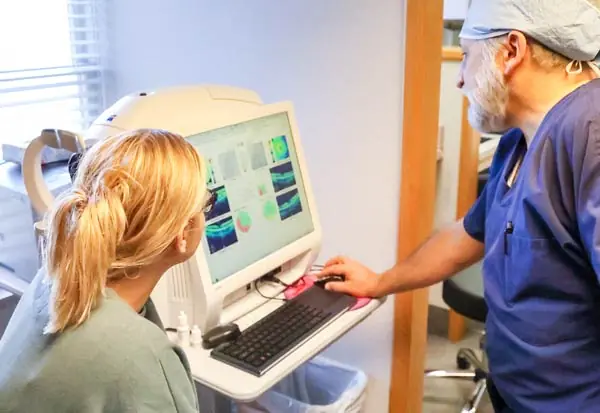
AMD is diagnosed at a dilated eye exam, where Dr. Rom sees drusen, pigment changes or fluid in the macula; retinal imaging (OCT) measures the layers of the macula precisely and shows whether fluid is present. Dry AMD is managed with monitoring and, for intermediate disease, a specific vitamin formula (AREDS2) that slows progression. Wet AMD is treated with injections of medication that stop the abnormal vessels from leaking.
The injections — anti-VEGF drugs given into the eye after numbing, usually every one to three months — have transformed wet AMD from a disease that reliably took central vision into one where most patients keep it. Dr. Rom monitors your macula at the Mentor office and coordinates prompt referral to a retina specialist when injections are needed.
- Early dryMonitoring; stop smoking; diet rich in leafy greens and fish; UV protection.
- Intermediate dryAREDS2 vitamin formula (vitamins C and E, zinc, copper, lutein, zeaxanthin) slows progression; home Amsler grid checks.
- WetAnti-VEGF injections by a retina specialist, repeated as needed; occasionally laser.
- AdvancedLow-vision aids and magnifiers make the most of remaining vision.
Common questions about macular degeneration
Short answers to the questions patients ask most often. For anything specific to your eyes, ask Dr. Rom at your visit or call the office at (440) 286-1188.
Will macular degeneration make me blind?
AMD affects central vision, not peripheral vision, so it does not cause total blindness. Advanced disease can make reading and recognizing faces very hard, which is why early detection and treatment matter.
Do vitamins help macular degeneration?
For intermediate dry AMD, the AREDS2 formula slows progression to advanced disease. It does not help early AMD or prevent AMD in people who do not have it. Dr. Rom will tell you whether it applies to you.
How is wet AMD treated?
With injections of anti-VEGF medication into the eye, given by a retina specialist after numbing, usually every one to three months. They stop the abnormal vessels from leaking and most patients keep their vision.
Can I still have cataract surgery if I have AMD?
Usually yes, and it often helps, though the result depends on the health of the macula. Dr. Rom evaluates the retina before surgery and explains what improvement to expect.
How often should I be examined?
With AMD, typically every 6–12 months, more often if it is advancing; with a family history, yearly dilated exams after 55. Any sudden distortion or blank spot should be examined the same day.
Protect your central vision.
Request an eye exam with Dr. Rom in Mentor. A dilated exam and retinal imaging find macular degeneration early, when treatment works best.