
- Home
- Cataract surgery
- Laser-assisted cataract surgery
Laser-Assisted Cataract Surgery
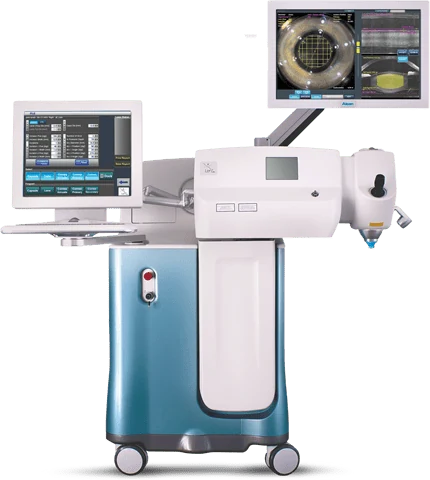
Laser-assisted cataract surgery uses the Alcon LenSx® femtosecond laser to make the incisions, open the lens capsule and soften the cataract with computer-guided precision before the lens is removed and the implant placed. Dr. Michael E. Rom offers it at Insight Eye Center in Mentor as an optional upgrade to standard cataract surgery, and tells you whether it makes sense for your eyes.
What is laser-assisted cataract surgery?
Laser-assisted cataract surgery uses a femtosecond laser — at Insight Eye Center, the Alcon LenSx® — to perform the first steps of cataract surgery that are otherwise done by hand: the corneal incisions, the circular opening in the lens capsule, and the softening of the cataract before it is removed. The lens implant is then placed as in standard surgery.
The laser is guided by a live image of your eye, so each incision is placed at a programmed depth, size and position. Softening the cataract with the laser first means less ultrasound energy is needed to remove it. The same laser can place the arc-shaped incisions that correct mild astigmatism — see limbal relaxing incisions.
Laser-assisted surgery is an optional, out-of-pocket upgrade. Dr. Rom will tell you plainly whether it makes sense for your eyes; for many patients standard surgery gives an equally good result.
How is laser-assisted surgery different from standard cataract surgery?
Both remove the cataract through a tiny incision and replace it with a lens implant, and both take about 10–15 minutes. The difference is how the first steps are made: with the laser, the incisions and the capsule opening are made by computer-guided laser rather than by hand, and the cataract is pre-softened. Recovery, results and lens options are otherwise the same.
- IncisionsLaser: programmed depth, size and position. Standard: made by hand with a blade — the technique Dr. Rom has used in tens of thousands of procedures.
- Capsule openingLaser: a precisely circular, centered opening. Standard: made by hand.
- Removing the lensLaser: the cataract is softened first, so less ultrasound is needed. Standard: ultrasound breaks up and removes the lens.
- AstigmatismLaser: arc incisions can be placed by the laser. Standard: limbal relaxing incisions by hand, or a toric lens.
- CostLaser: an out-of-pocket upgrade. Standard: covered by Medicare and most plans, subject to deductible and coinsurance.
What happens during laser-assisted cataract surgery?
Surgery day is the same as for standard cataract surgery, with one extra step at the start: after numbing drops, a few minutes at the laser, where a gentle suction ring holds the eye steady while the laser makes the incisions and softens the cataract. Dr. Rom then removes the lens and places the implant, and you go home the same day.
- Numbing drops and a mild sedativeThe eye is numbed with drops; a sedative can help you relax. You are awake but comfortable throughout.
- ImagingThe LenSx system images your eye and Dr. Rom confirms the plan — incision positions, the capsule opening and any astigmatism arcs — on screen.
- The laser stepA soft ring holds the eye steady for a short time while the laser works; you may feel pressure and see lights. It takes a few minutes.
- Removing the cataractThe pre-softened lens is removed with ultrasound through the laser-made incision.
- The implantThe folded lens implant is placed in the capsule and unfolded into position. No stitches are needed.
- Home the same dayWith a driver, drops to start, and a next-day check at the Mentor office. Recovery follows the same timeline as standard cataract surgery.
Is laser-assisted cataract surgery covered by insurance?
The cataract surgery itself is covered by Medicare and most insurance plans when it is medically necessary, subject to your deductible and coinsurance. The laser step is an additional out-of-pocket charge, because insurers consider it — like premium lenses and astigmatism correction — an elective refinement rather than a medical necessity.
The office gives you the cost before you decide, and CareCredit and Alphaeon financing is available — see financing. Laser-assisted surgery is often chosen together with a premium lens; ask the office how the two are priced together.
What a great experience! After 50 years of prescription glasses and the recent onset of cataracts, I can now see better than ever! With each eye, the stay at the surgery center was only a couple of hours and the actual procedure was very quick and completely painless.Alan H. · cataract surgery
Common questions about laser-assisted surgery
Short answers to the questions patients ask most often. For anything specific to your eyes, ask Dr. Rom at your visit or call the office at (440) 286-1188.
Is laser cataract surgery better than standard surgery?
Not for everyone. Both give excellent results in experienced hands. The laser adds precision to the incisions and the capsule opening and can reduce ultrasound energy, which matters most for premium lenses, astigmatism correction and dense cataracts. Dr. Rom tells you whether it makes sense for your eyes.
Is the laser painful?
No. The eye is numbed with drops. During the laser step you feel pressure from the ring that holds the eye steady and see some lights; it lasts a few minutes.
Does laser surgery take longer?
It adds a few minutes at the laser before the cataract is removed. The whole procedure is still brief, and you go home the same day.
Is the recovery different?
No. Recovery follows the same timeline as standard cataract surgery: a next-day check, drops for a few weeks, and about two weeks without swimming, hot tubs or heavy lifting.
Is this the same as LASIK?
No. LASIK reshapes the cornea to correct a glasses prescription and Insight Eye Center does not perform it. Laser-assisted cataract surgery uses a different laser to perform steps of cataract surgery.
Which laser does Dr. Rom use?
The Alcon LenSx® femtosecond laser.

Is the laser right for your eyes?
Request a cataract evaluation with Dr. Rom in Mentor. He will tell you whether laser-assisted surgery, a premium lens, or standard surgery is the right plan — and why.