
- Home
- Cataract surgery
- Lens options
Lens Implant Options for Cataract Surgery
Every cataract surgery includes an intraocular lens (IOL) that replaces the eye's clouded natural lens. At Insight Eye Center in Mentor, Dr. Michael E. Rom offers a standard lens for clear distance vision, a toric lens that also corrects astigmatism, and extended-range lenses designed to reduce your dependence on glasses — and he tells you which ones suit your eyes.
What is a lens implant (IOL)?
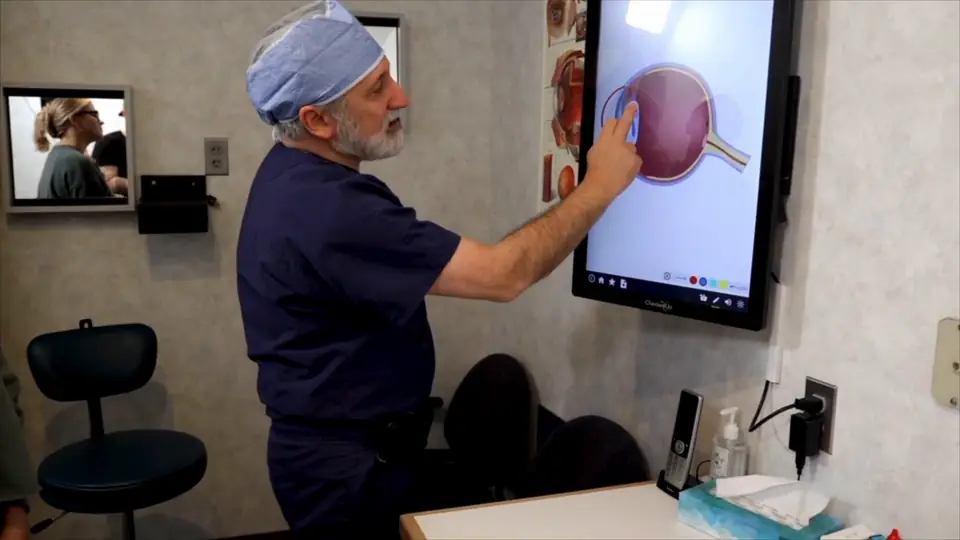
An intraocular lens, or IOL, is the clear artificial lens placed inside your eye during cataract surgery to replace the clouded natural lens. Every cataract surgery includes one. The lens is folded, inserted through the same tiny incision used to remove the cataract, and unfolds into the capsule that held your natural lens, where it stays permanently.
The power of the lens is calculated from no-contact measurements of your eye taken before surgery, so the implant is matched to your eye. What varies is the optical design: a standard lens gives one clear focal distance, a toric lens also corrects astigmatism, and extended-range designs are made to give useful vision across a wider span of distances.
The surgery itself is the same whichever lens you choose — only the implant is different.
What are the types of lens implants?
There are four types of lens implant to talk through with Dr. Rom: a standard monofocal lens for clear distance vision with reading glasses for close work, a toric lens that corrects astigmatism at the same time, an extended-range lens designed to reduce your dependence on glasses, and a full range of vision trifocal that adds near vision as well. Your exam and measurements determine which ones suit your eyes.

One clear focal distance, usually set for far. Reading glasses for close work. Covered by Medicare and most plans when surgery is medically necessary; deductibles and coinsurance still apply.

A standard-style lens with astigmatism correction built in, so distance vision is sharp without glasses. An additional out-of-pocket cost.

Designed for distance and arm's-length tasks, with some near vision. An additional out-of-pocket cost.

A trifocal designed to give distance, arm's-length and near vision from one implant. An additional out-of-pocket cost.
Which lens implants does Dr. Rom use?
Insight Eye Center currently implants six lenses: enVista® (standard monofocal), enVista® Toric (astigmatism-correcting), enVista® Aspire™ (a monofocal designed for a broader range of focus), TECNIS® PureSee™ (an extended-depth-of-focus lens), and enVista® Envy™ and enVista® Envy™ Toric (full range of vision trifocals). Dr. Rom recommends one of them after your measurements, based on your eyes, your astigmatism and how you want to use your vision.
enVista® — standard monofocal
Bausch + Lomb's hydrophobic acrylic lens with one focal distance, usually set for far. The lens most patients receive, and the one covered by Medicare and most plans. Reading glasses for close work; mild astigmatism can be treated with incisions at surgery.
enVista® Toric — for astigmatism
The same lens with astigmatism correction built in, including low amounts. Sharper distance vision without glasses for eyes with corneal astigmatism. Read more on the toric lens implants page. An out-of-pocket upgrade.
enVista® Aspire™ — broader range of focus
Described by Bausch + Lomb as a monofocal designed for a broader range of focus than a standard lens — distance plus arm's-length tasks such as the dashboard or a countertop. It is not a multifocal lens; expect reading glasses for fine print. A toric version is available. An out-of-pocket upgrade.
TECNIS® PureSee™ — extended depth of focus
Johnson & Johnson's refractive (non-diffractive) extended-depth-of-focus lens, designed for distance and intermediate vision with some near vision while keeping halos and glare low. In the manufacturer's clinical study, 97% of patients reported no very bothersome visual disturbances — a manufacturer figure, not this practice's results. An out-of-pocket upgrade.
enVista® Envy™ — full range of vision
Bausch + Lomb's trifocal lens, FDA approved in October 2024, designed to provide distance, arm's-length and near vision from one implant — the option for patients who would rather not depend on reading glasses. Built on the same glistening-free enVista material as the standard lens. In the manufacturer's US clinical study, 86% of patients reported little or no problem with glare, halo or starbursts — a manufacturer figure, not this practice's results. An out-of-pocket upgrade.
enVista® Envy™ Toric — full range of vision with astigmatism correction
The same trifocal with astigmatism correction built into the lens, for eyes that have both a cataract and corneal astigmatism. Bausch + Lomb reports 94.4% of eyes rotated 5 degrees or less at 180 days after surgery. Whether your astigmatism is better treated with a toric lens or with incisions at surgery is decided from your measurements. An out-of-pocket upgrade.
Astigmatism correction at surgery
Mild corneal astigmatism can also be corrected with limbal relaxing incisions during the same procedure, and laser-assisted surgery with the LenSx® laser can place those incisions precisely. Dr. Rom recommends the approach that fits the amount of astigmatism in your eye.
Compare the lens options in detailThe six lenses Dr. Rom implants, side by side.
| Lens | Type | Distance | Arm's length | Near | Astigmatism | Coverage |
|---|---|---|---|---|---|---|
| enVista® Bausch + Lomb | Standard monofocal | Yes | Partial | Reading glasses | Correctable with incisions at surgery | Medicare and most plans |
| enVista® Toric Bausch + Lomb | Toric monofocal | Yes | Partial | Reading glasses | Built in, including low amounts | Out-of-pocket upgrade |
| enVista® Aspire™ Bausch + Lomb | Intermediate-optimized monofocal | Yes | Designed for arm's-length tasks | Reading glasses for fine print | Toric version available | Out-of-pocket upgrade |
| TECNIS® PureSee™ Johnson & Johnson | Extended depth of focus | Yes | Yes | Some | Ask about options | Out-of-pocket upgrade |
| enVista® Envy™ Bausch + Lomb | Full range of vision (trifocal) | Yes | Yes | Yes | Toric version available | Out-of-pocket upgrade |
| enVista® Envy™ Toric Bausch + Lomb | Full range of vision (trifocal) | Yes | Yes | Yes | Built in | Out-of-pocket upgrade |
TECNIS PureSee is a refractive (non-diffractive) lens designed to keep halos and glare low; in Johnson & Johnson's clinical study, 97% of patients reported no very bothersome visual disturbances. That figure comes from the manufacturer's study, not from this practice's patients. enVista Aspire is described by Bausch + Lomb as designed for a broader range of focus than a standard monofocal; it is not a multifocal lens. enVista Envy is Bausch + Lomb's full range of vision trifocal, FDA approved in October 2024 in standard and toric models; in the manufacturer's US clinical study 86% of patients reported little or no problem with glare, halo or starbursts. Manufacturer figures are not this practice's results.
How do I choose the right lens implant?
Start with how you want to use your eyes after surgery. If clear distance vision is the goal and reading glasses do not bother you, a standard lens is the simplest choice. If you have astigmatism, a toric lens or incisions at surgery sharpen distance vision. If you would rather depend on glasses as little as possible, ask about the extended-range options.
Your measurements matter as much as your preferences: the health of the cornea and retina, the amount and type of astigmatism, and whether you have had previous eye surgery all affect which lenses are suitable. Dr. Rom goes over the options at your cataract evaluation and tells you plainly which ones make sense for your eyes.
The optional Lens Finder below gives you a starting point for that conversation. It does not decide which lens you can have.
Not sure which type to ask about? Try the optional Lens FinderFour questions give you a starting point for the conversation. Your answers do not decide which lens you can have.
After cataract surgery, what would you like your eyes to do?
Have you been told you have astigmatism?
Standard lenses are covered by Medicare and most insurance, subject to your deductible and coinsurance. Upgraded lenses are an additional out-of-pocket cost. Which sounds like you?
If you could skip glasses for one more thing, what would it be?
Are premium lens implants covered by insurance?
Not usually. Medicare and most insurance plans cover cataract surgery with a standard monofocal lens when the surgery is medically necessary, subject to your deductible and coinsurance. Toric and extended-range lenses are an additional out-of-pocket cost, as is laser-assisted surgery, because they treat something insurance considers elective: your dependence on glasses.
The surgery, the surgeon's fee and the facility are still covered the same way whichever lens you choose, since the procedure itself is the same. The office gives you the upgrade cost in writing before you decide, and CareCredit and Alphaeon financing is available — see financing.
The professionalism of Dr. Rom and his staff is refreshing. The communication regarding the surgery was excellent. Most important to me was that my cataract surgery was completely painless. I will highly recommend Dr. Rom to my friends.B. B. · cataract surgery
Common questions about lens implants
Short answers to the questions patients ask most often. For anything specific to your eyes, ask Dr. Rom at your visit or call the office at (440) 286-1188.
Do I have to choose a premium lens?
No. A standard monofocal lens gives excellent distance vision for most eyes and is what most patients receive. Premium lenses are an option for people who want less dependence on glasses; they are never required.
Is the surgery different with a premium lens?
No. The cataract is removed the same way and the lens is placed through the same small incision. Only the implant, and sometimes the pre-operative planning, is different.
Can I have a different lens in each eye?
Sometimes. Dr. Rom occasionally plans the two eyes differently, for example to balance distance and near vision. Whether that suits you depends on your measurements and how you use your eyes; he will discuss it if it is an option.
Will I still need reading glasses?
With a standard or toric lens set for distance, yes, for close work. Extended-range lenses are designed to reduce that need for arm's-length tasks and, to a degree, for near vision, but many patients still use readers for fine print.
Can a lens implant be changed later?
Lens exchange is possible but rarely necessary; it is a second surgery and carries its own risks. That is why the measurements, and the conversation about your goals, happen before the first surgery.
Does Insight Eye Center offer PanOptix, Vivity or LASIK?
Dr. Rom currently implants enVista, enVista Toric, enVista Aspire, TECNIS PureSee, enVista Envy and enVista Envy Toric lenses. Insight Eye Center does not perform LASIK. Ask the office if you have been told you need a specific lens.
Which lens is right for your eyes?
Request a cataract evaluation with Dr. Rom in Mentor. The visit includes the measurements that determine which lens implants suit your eyes, and a plain conversation about the options.