
- Home
- Cataract surgery
- ZEISS VERACITY & CALLISTO eye
ZEISS VERACITY and CALLISTO eye
ZEISS VERACITY surgical planning software and the CALLISTO eye alignment system help Dr. Michael E. Rom calculate the right lens implant power and align toric lenses precisely during cataract surgery at Insight Eye Center in Mentor. Combined with no-contact eye measurements, they let each surgery be planned for the individual eye rather than an average one.
What do VERACITY and CALLISTO eye do?
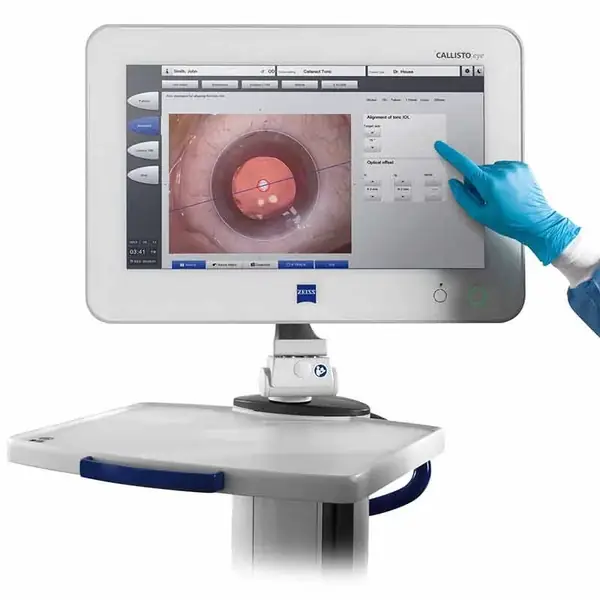
ZEISS VERACITY is surgical planning software: it combines your eye measurements to calculate the lens implant power and, for toric lenses, the exact axis of alignment. CALLISTO eye then projects that plan into Dr. Rom's operating microscope during surgery, so the incisions and the toric lens are aligned to your eye without ink marks. Together they make cataract surgery more precise.
Before surgery, no-contact instruments such as the IOLMaster measure the length of your eye and the curvature of your cornea. VERACITY brings those numbers together with the lens data to refine the lens selection and the surgical plan. In the operating room, CALLISTO eye matches a reference image of your eye to the live view, tracks it, and overlays the planned positions.
The result is precise lens-power calculation, precise toric alignment, and a surgery customized to each patient's eye — which is how most patients today achieve visual outcomes that were only a hope a decade ago.
Why does alignment matter for a lens implant?
A toric lens corrects astigmatism only when it sits at the right angle. Even a few degrees of rotation reduces the correction, so the axis measured before surgery has to be reproduced exactly in the operating room. Marking the eye by hand with ink is the traditional method; CALLISTO eye replaces it with a tracked digital overlay that does not smudge or shift.
Lens power is the other half of the outcome. The measurements that feed VERACITY determine whether you end up with the target focus — usually clear distance vision — or need glasses to fine-tune it. Better planning means fewer surprises.
- precise intraocular lens power calculation
- toric lens alignment without ink marks
- positioning of astigmatism-correcting incisions
- a surgical plan customized to each eye
What does this mean for my surgery?
Nothing extra is asked of you. The measurements happen at your cataract evaluation at the Mentor office, the planning happens before surgery day, and the alignment guidance is used inside the operating microscope. You may notice a brief photograph of your eye being taken at the evaluation; that is the reference image the system uses.
Where it shows is in the result: a toric lens that corrects what it was meant to correct, and a lens power chosen from the best available data. Dr. Rom explains at your evaluation which lens options suit your eyes — see lens options and toric lens implants.
Common questions about surgical planning
Short answers to the questions patients ask most often. For anything specific to your eyes, ask Dr. Rom at your visit or call the office at (440) 286-1188.
Is CALLISTO eye a laser?
No. It is an imaging and guidance system that projects the surgical plan into the operating microscope. The laser used for laser-assisted cataract surgery is the separate Alcon LenSx system.
Do I need these tools for a standard lens?
The lens-power planning benefits every patient. The alignment overlay matters most for toric lenses and astigmatism-correcting incisions, where the angle has to be exact.
Does the planning add time or visits?
No. The measurements are taken at your cataract evaluation, and the planning is done by Dr. Rom before surgery day.
Where can I read about the measurements?
The cataract surgery page describes the exam and the no-contact measurements taken before surgery, including the IOLMaster 700 and OPD-Scan III.
Surgery planned for your eye.
Request a cataract evaluation with Dr. Rom in Mentor. The measurements taken at the visit are the starting point of the surgical plan.