The Alcon LenSx Laser
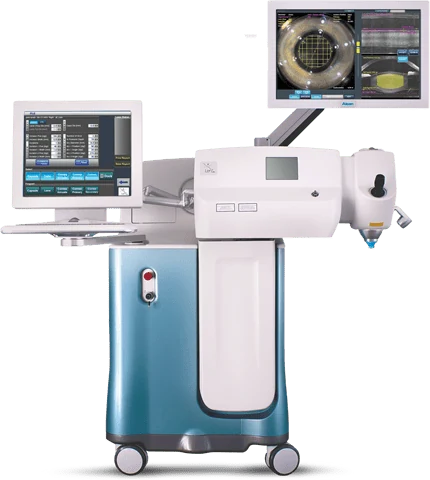
The Alcon LenSx® is the femtosecond laser used for laser-assisted cataract surgery with Dr. Michael E. Rom. Guided by a three-dimensional scan of your own eye, it makes the corneal incisions, opens the lens capsule and softens the cataract — before Dr. Rom removes it and places your lens implant.
What is the LenSx laser?
The LenSx is a femtosecond laser built by Alcon — an infrared laser that fires pulses lasting quadrillionths of a second. Each pulse forms a microscopic bubble exactly where it is aimed, and thousands of them placed side by side make a cut inside the eye, without a blade ever touching the tissue.
Femtosecond lasers were first cleared by the FDA for a step of cataract surgery in 2009, when the LenSx was cleared to open the lens capsule; clearance for corneal incisions followed the same year, and Alcon bought LenSx Lasers in 2010. Today the system is cleared for corneal incisions — including the arc-shaped ones that correct astigmatism — for opening the lens capsule, and for softening the cataract before it is removed.
It is the same class of laser used to make the flap in LASIK, tuned and aimed for a different job. Insight Eye Center does not perform LASIK; the LenSx here is used only as part of laser-assisted cataract surgery.
What does the LenSx laser do during cataract surgery?
Three of the steps that are otherwise done by hand, plus an optional fourth. It cuts the openings in the cornea, cuts the circular window in the capsule that holds the cataract, and divides and softens the cataract itself. If you are having astigmatism corrected, it can also place the arc-shaped incisions.
- Corneal incisionsThe small openings Dr. Rom works through, cut to a planned width, depth and position rather than made freehand with a blade.
- CapsulotomyThe round window in the front of the lens capsule. The laser cuts it to a set diameter and centers it on your lens, which is where a premium implant has to sit to work as designed.
- Lens fragmentationThe cataract is scored into segments and softened, so less ultrasound energy is needed to remove it.
- Arcuate incisions optionalCurved incisions in the cornea that flatten mild astigmatism — the laser version of limbal relaxing incisions.
How does the laser know where to cut?
It scans your eye first. An OCT camera built into the machine takes a cross-sectional, three-dimensional picture of your cornea, your lens capsule and the cataract behind it. Dr. Rom sees that scan on screen, sets each cut against your own anatomy, and approves the plan before any laser is fired.
- DockingA sterile, single-use interface with a soft curved contact lens rests on the eye and holds it steady with gentle suction. The eye is numb; you feel pressure rather than pain.
- The scanThe OCT images the eye through the interface and maps the cornea, the front and back of the lens capsule, and the cataract in three dimensions.
- The planThe incision positions, the capsule opening and any astigmatism arcs are drawn onto that scan. Dr. Rom checks them against your measurements and adjusts them before confirming.
- The laserThe cuts are made in sequence. You may see lights and hear a soft clicking. Alcon rates the suction time at under two minutes.
- UndockingThe interface comes off and you are moved to the operating microscope, where Dr. Rom removes the softened cataract and places your implant.
Should you have the laser step?
It is optional and it is not free. Medicare and insurance cover cataract surgery itself but treat the laser as an elective refinement, so it is an out-of-pocket charge. Dr. Rom will tell you plainly whether he thinks it will change the result in your eyes, and many patients do very well without it.
The full comparison — laser against standard surgery, step by step, and what the upgrade costs — is on the laser-assisted cataract surgery page. Payment plans are on the financing page.
- premium and toric implants, where the capsule opening has to be centered
- mild astigmatism being corrected during surgery
- dense cataracts that would otherwise need more ultrasound
Common questions about the LenSx laser
Short answers to the questions patients ask most often. For anything specific to your eyes, ask Dr. Rom at your visit or call the office at (440) 286-1188.
Who makes the LenSx laser?
Alcon. The system was developed by LenSx Lasers and acquired by Alcon in 2010. It was the first femtosecond laser cleared by the FDA for a step of cataract surgery, in 2009.
Does the laser remove the cataract?
No. The laser softens and divides the cataract and makes the openings; Dr. Rom then removes it with ultrasound and places your lens implant by hand, as in standard cataract surgery.
Is the LenSx the same as LASIK?
No. Both use femtosecond lasers, but LASIK reshapes the cornea to correct a glasses prescription. The LenSx performs steps of cataract surgery. Insight Eye Center does not perform LASIK.
Does the laser hurt?
No. The eye is numbed with drops beforehand. During the laser step you feel pressure from the ring holding the eye steady and may see lights; the suction lasts under two minutes.
Does choosing the laser limit my lens options?
No. Every implant Dr. Rom offers, from a standard monofocal to a toric or extended-range lens, can be used with or without the laser step.
Is the LenSx covered by insurance?
The cataract surgery is covered; the laser step is not. Insurers treat it as an elective upgrade, so it is an out-of-pocket charge quoted to you before you decide.
Ask whether the laser is worth it for your eyes.
Request a cataract evaluation with Dr. Rom in Mentor. He will measure your eyes and tell you whether the laser step, a premium lens, or standard surgery is the right plan — and why.